Decorating with flea market finds isn't about filling your home with old things. It's about choosing the right pieces and placing them the right way – so that they lift the room rather than disturb it. Here are ten concrete tips from interior designers and seasoned flea market traders.
1. Choose a recurring material or a colour palette
The most common mistake is mixing too many periods, styles and colours without a unifying element. Pick a theme to stick to – natural materials such as wood and linen, a neutral palette of grey and beige, or a specific period such as the 1950s–1970s. As long as you stick to a theme, you can mix freely within it without it looking cluttered.
2. Let a single piece dominate the room
One large, striking piece of furniture – a teak sideboard, a Rococo-Gustavian writing desk, a 1970s lamp with a dramatic shape – carries more visual power than ten smaller finds. Place your strongest piece and build the rest of the room around it. The rest can be simpler.
3. Mix eras deliberately
Mixing periods works well if you do it actively, not at random. The classic move is to set a modernist chair from the 1950s against a table in the Gustavian style – the contrast is great enough to be interesting rather than jarring. Avoid half-steps: 1970s furniture against 1980s furniture against 1990s furniture gives you no contrast and no clarity.
4. Mix new with second-hand
The home looks more considered if you mix flea market finds with new pieces. An old chest of drawers on a brand-new floor, a flea market textile against a new sofa, a vintage piece on a modern bookshelf. It's the contrast that makes the find visible and interesting – in a room crammed full of antiques, every piece disappears into the noise.
5. Lean on textiles for softness and warmth
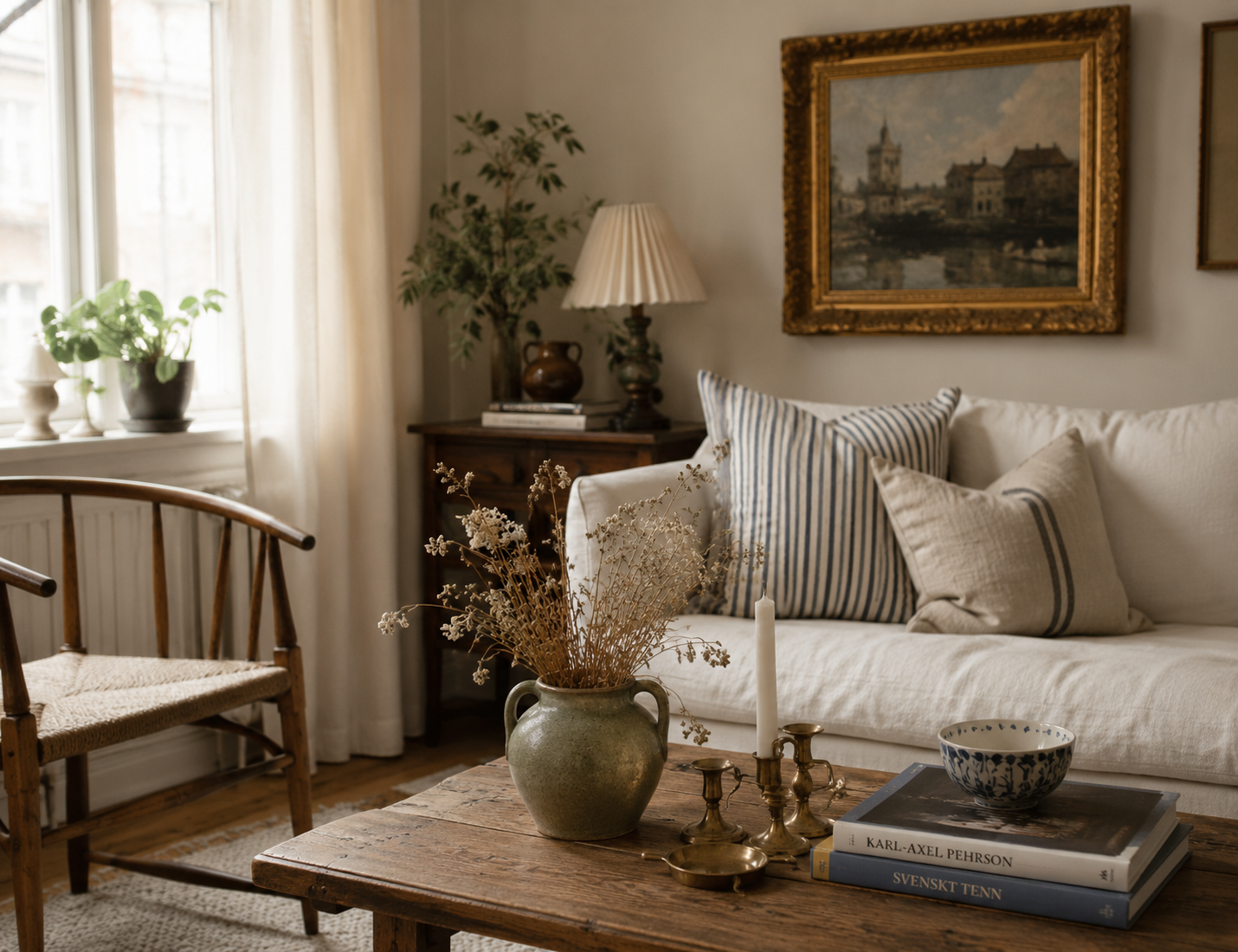
Textiles – curtains, cushions, rugs, tablecloths – are the quickest way to warm up a room and disguise the fact that the furniture doesn't match perfectly. Linen and wool in natural tones are hard to get wrong. Old woven rugs from the Rölakan tradition or Rya rugs in muted colours add texture and history without dominating.
Loppos tip
Photograph your home before you buy — it's easy to forget which colours and measurements you actually have room for.
6. Buy for function, not just because it's pretty
Flea market finds that get used every day are made visible in a different way than decorative pieces gathering dust. An old coffee pot you actually brew in. The cutlery set you bring out at dinner. The lamp that lights the reading corner. Function creates the authenticity that separates a lived-in home from a museum.
7. Declutter more than you think you need to
For every flea market find you bring home, think about what's leaving. This isn't an ironic piece of advice – it's practical interior logic. Overloaded shelves, tables and walls drain the power out of individual pieces. Give your best finds some air around them.
8. Take your time with placement
Where you put a piece decides whether it feels considered or random. Try different positions – against walls, grouped with other pieces, alone on a shelf. A simple lamp in an unexpected spot in the room makes more of an impression than the same lamp in the standard position.
9. Go easy on "collectibles"
Groupings work visually if they're consistent: a row of identical bottles, a collection of blue ceramics, a packed wall of botanical prints. What doesn't work is loosely assembled groups of objects with no clear logic. If you're amassing flea market finds that don't relate to one another – pick out three and put the rest away.
10. Trust patina, not a full restoration
A piece of furniture that bears the marks of time – a little wear on the edge, a slight fading of the wood, an original finish that has dulled – looks more authentic in a home than one filled and sanded back to brand-new condition. Authenticity is vintage interiors' strongest argument against new pieces. Don't sand it away.