Gustavian style is one of the most loved – and most faked – styles in Swedish interior-design history. The style emerged during the reign of Gustav III (1771–1792) as a Swedish interpretation of French neoclassicism, and has since lived a life of its own in reproductions, interpretations and genuine original pieces. This guide will help you tell the genuine article from the merely Gustavian-inspired.
The origins of the style
Gustav III's travels in Italy and France during the 1770s brought home a new aesthetic vision to Sweden. The dark mahogany and heavy gilding of the pompous Baroque were replaced by a lighter, more elegant idiom drawn from the archaeological excavations of ancient Rome and Pompeii.
The result – the Gustavian style – is one of Sweden's most successful design exports. It was later exported to the United States as "Swedish grace" and has periodically come back into fashion, most recently very strongly during the 2010s and 2020s.
Four signs to look for
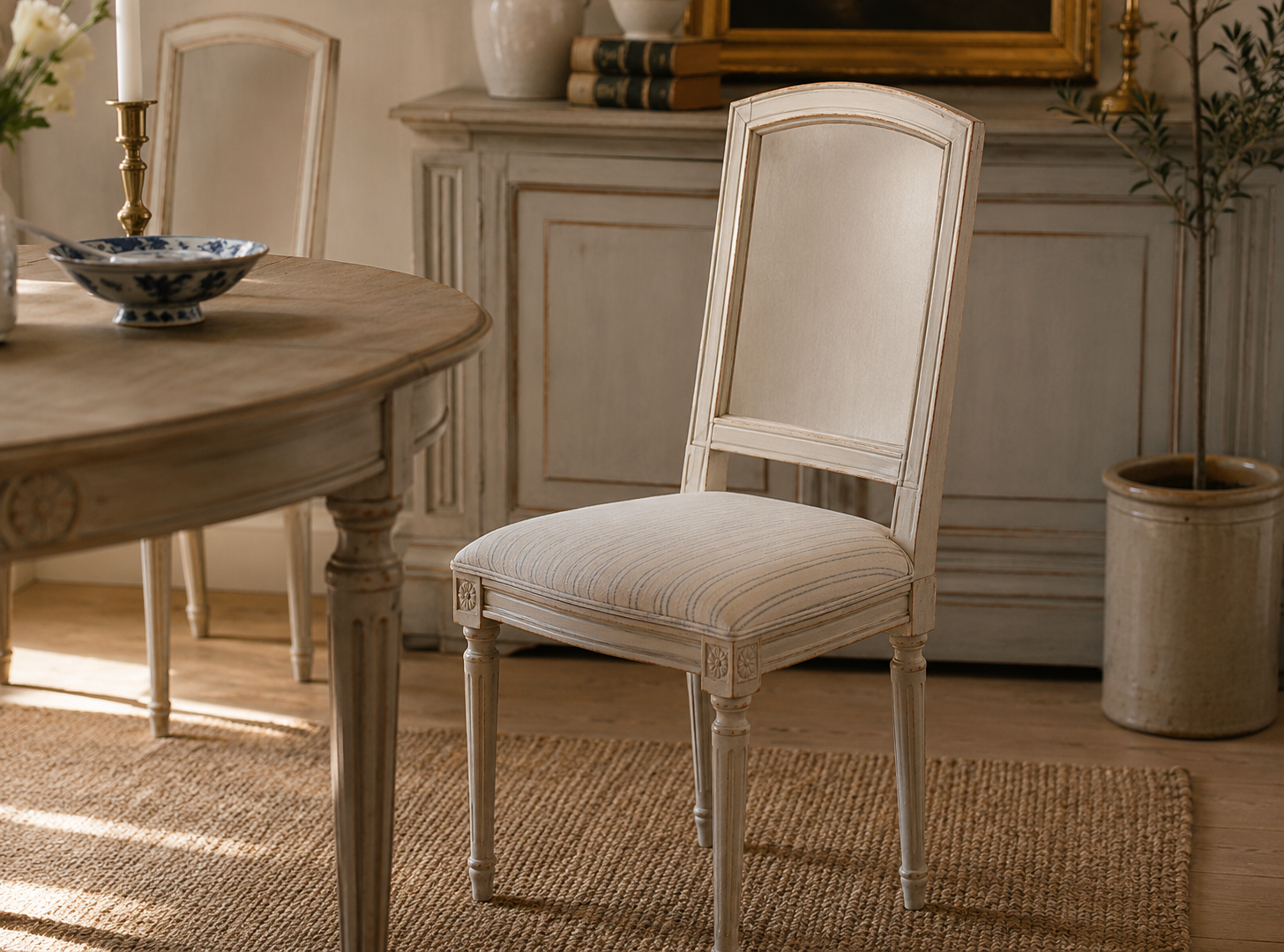
1. The pale wood Gustavian furniture is made from pale wood – birch, beech or alder – often painted in white, grey, pale blue or Gustavian yellow. The dark mahogany of the Baroque era is gone. If you see a piece with pale legs and pale paintwork, that's a strong Gustavian signal.
2. The slender, tapering legs Gustavian chairs and tables have characteristic tapering straight legs – chairs with square tapering legs in birch are iconic. The legs sometimes end in a small block foot (a wooden foot) but never in a claw or animal foot as in Baroque furniture.
3. The classic ornamental motifs Gustavian decoration draws on antiquity: wreaths of laurel, bundles of arrows, urns, festoons (hanging garlands of flowers) and anthemion patterns (a stylised honeysuckle flower). The decoration is restrained and regular, never overloaded.
4. The shape of the splat The splat of a Gustavian chair is one of the surest marks of identification. Classic shapes are oval (medallion back), square with cut corners and the characteristic fan shape, with rays radiating out from a central point.
Loppos tip
"Gustavian style" on the price tag often means newly made in the style — ask outright whether the piece is from the period or merely inspired by it.
Karl Johan – the extension of Gustavianism
The Karl Johan style (1810–1840) is Gustavianism's heavier cousin: still pale wood and straight legs, but more pompous and ceremonial. Karl Johan furniture is often larger, with bolder ornamentation in the form of lion's paws, eagles and festoons in brass or gilded wood.
Karl Johan is often confused with Gustavian – remember: Karl Johan is heavier, Gustavian is lighter and more restrained.
Original or reproduction?
Genuine Gustavian furniture from the 1780s–1820s is rare and expensive – an original chair can fetch 10,000–50,000 kronor at Bukowskis. There is, however, a long tradition of well-made reproductions from the mid-20th century and the 1970s–80s that make beautiful pieces for the home at reasonable prices.
Look at: the joinery (handmade joints with wooden pegs vs. modern screws), the patina of the paintwork (an original has an even, aged patina, a newer copy has flat, even white paint) and the wood beneath the paint (birch or alder indicates authenticity, chipboard indicates a copy).