Carl Malmsten is one of Sweden's most sought-after furniture designers, and his chairs turn up at flea markets and auctions at regular intervals. The trouble is that the originals are hard to tell apart from the countless copies and tributes produced since his breakthrough in the 1920s. This guide gives you the tools to decide whether the chair in front of you is a genuine Malmsten original.
Who was Carl Malmsten?
Carl Malmsten (1888–1972) won a design competition in 1916 for the furniture of Stockholm City Hall and made his name as the leading voice for Swedish craftsmanship in opposition to the mass production of industrialism. He founded his own schools and workshops and left behind an archive of more than 20,000 furniture sketches and drawings.
His best-loved models – Lilla Åland, Farmor, Herrgården, Samsas and Vardag – are still produced by authorised makers and sold as living classics.
Look at the stamp first
The most important step is to look for a maker's stamp under the seat, on the back of the splat or on an underlying cross-rail. Authorised Malmsten makers have historically included O.H. Sjögren, Stolab, Tre Sekel and Gemla. A stamp from one of these factories combined with the Malmsten name is a strong sign of a legitimate piece.
Older original chairs from the Malmsten shop in Stockholm may carry labels bearing the mark "Carl Malmsten" in printed text. A complete absence of any stamp is a warning sign – but not absolute proof of a copy, since labels can come loose over the years.
The timber and the workmanship
Malmsten used almost exclusively Swedish timbers – birch, alder, beech and cherry. He held a matter of principle against tropical woods and against veneer: the construction was to be honest and the wood visible. If you see teak, walnut or some unknown exotic wood in a chair claimed to be a Malmsten, that is a warning sign.
The finish of the joints is another key. Malmsten's joiners maintained a high standard of quality – the joints should sit tight, the wood should be well planed and the surface treatment even, with no sharp edges or sanding marks.
Loppos tip
Unsure about a stamp? Photograph the marking in raking light and run the image through Loppos Scan — it matches against thousands of registered furniture marks.
The design language – what you see from a distance
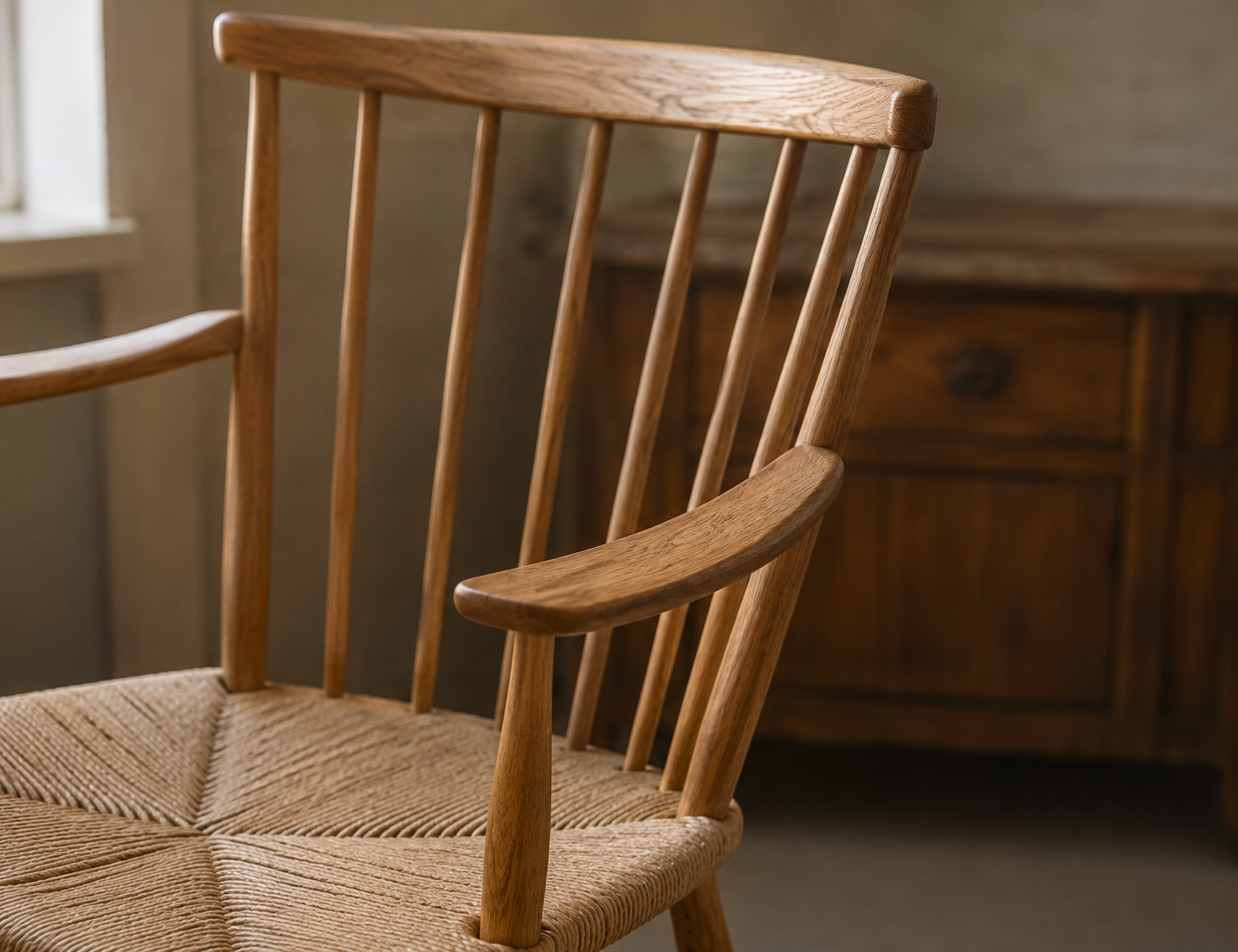
Malmsten chairs have an instantly recognisable design language: gently curved but never dramatic legs, a broad and comfortable seat, a splat in a single flat plane and a general sense of solidity without heaviness. The decoration is restrained – sometimes a simple carved cut-out in the splat, never overloaded.
The straight lines of Herrgården in birch and the softer armchair form of Farmor are the most common models on the flea-market scene. Learn the silhouettes by heart – they are hard to fake for anyone who has seen genuine examples.
Price as a clue
A genuine vintage Malmsten chair from the 1950s–1980s changes hands at auction for 2,000–8,000 kronor per chair depending on condition and model. If you find a chair for 200 kronor at a flea market with no stamp – be sceptical, but don't rule out that it could be a find. Always check the construction, the wood and any stamp before drawing conclusions.
Summary: checklist on the spot
Run through these points when you see a chair claimed to be a Malmsten:
A stamp or label from a known maker (O.H. Sjögren, Stolab, Tre Sekel, Gemla) – found under the seat or on the cross-rail. The timber is Swedish – birch, beech, alder or cherry. The construction is solid hardwood, no veneer panels. The design language matches a known Malmsten model. The joints and finish are of high craftsmanship.
If you still have questions, auction houses such as Bukowskis and Stockholms Auktionsverk can carry out preliminary valuations free of charge.