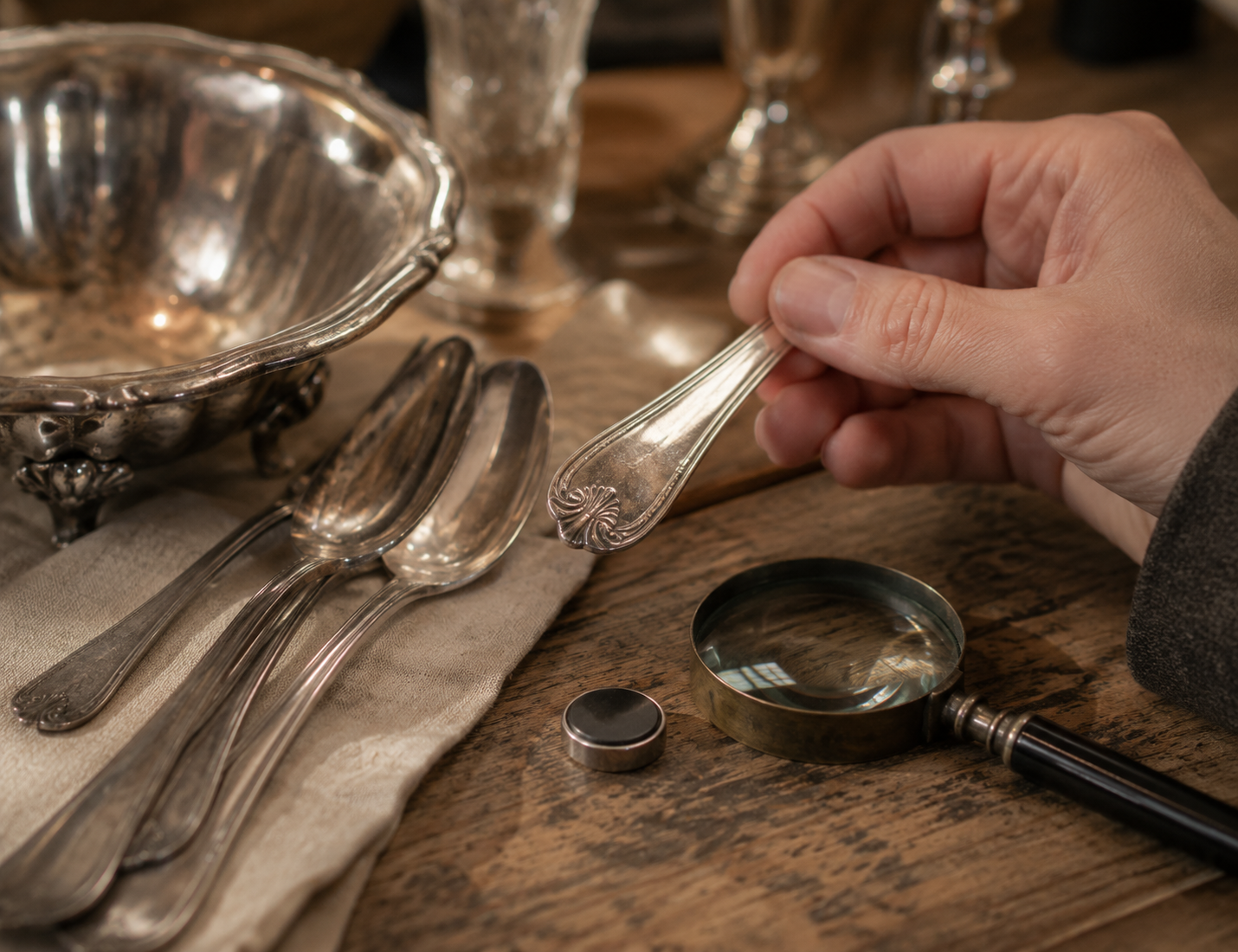
Silver is one of the most common finds at flea markets and antiques fairs — cutlery sets, jewellery, jugs, dishes and candlesticks move in large volumes on the second-hand market. The problem is that silver-coloured metal alloys and plated items are hard to tell apart from genuine silver with the naked eye. Here are three tests you can do right there on the spot.
The hallmark — always start here
The most important and quickest test is to find the hallmark. All genuine silver made in Sweden and in most European countries is stamped with the silver content expressed in thousandths:
925 = sterling silver (92.5% silver) — the most common content for jewellery and newer cutlery sets. 830 = an older Nordic standard, common in Swedish cutlery sets from the early 20th century. 800 = a lower content, common in older continental European silver. 999 = fine silver, almost pure, unusual in everyday items.
On Swedish silver items you'll often find a town guarantee mark (the crown symbol), a maker's mark with the maker's initials and a date mark in the form of a letter. These three marks together are very strong proof of authenticity.
The hallmark is usually in a discreet place — inside a ring, along the handle of a spoon, on the underside of a dish. Bring a torch.
The magnet test — quick and reliable
Silver is not magnetic. Hold a strong magnet (a neodymium magnet works best) against the item. If the item is pulled strongly towards the magnet it is not silver — most likely iron, nickel or a base alloy. Items that don't react at all to the magnet may be silver, but this doesn't prove they are silver — it only rules out iron and nickel.
A spoon or jug made of nickel silver (alpacca) doesn't react to the magnet either but contains no silver at all. The magnet test should always be combined with a hallmark check.
Loppos tip
Be careful with an acid test on the spot — it damages the item. Photograph the hallmarks and let Loppos Scan interpret them instead.
The bleach test — silver reacts quickly
A drop of ordinary bleach (sodium hypochlorite) on the item gives a quick reaction if it's genuine silver: the surface oxidises and darkens immediately. Silver items turn black on contact with bleach — that's a natural chemical behaviour of silver.
Plated items sometimes react in the same way on the plating layer, but irregularly. Plating that has worn through gives a different reaction in the base layer underneath. Bring bleach in a small plastic bottle. Always test in a discreet spot — a chip under the foot or an invisible point on the underside.
The acid test — for the meticulous
An acid test for silver (nitric acid or dedicated silver-testing kits costing 100–200 kronor at jewellers') gives a colour reaction depending on the silver content. Bright red = pure silver. Darker red = 925 sterling. Brown = 800 silver. Green = 500 silver or lower. Yellow/no reaction = not silver.
The acid test is invasive — it leaves a small mark — and is usually only done by someone seriously interested in a specific item.
What is the silver worth?
The flea-market price for silver is governed by weight and design. The pure silver content (the melt value) can be calculated from the current silver price multiplied by the weight in grams and the silver content. A cutlery set in 830 silver weighing 1 kg contains around 830 grams of pure silver — worth roughly 300–400 kronor in metal value in 2026.
The antique value can be far higher: a cutlery set by Wiwen Nilsson, Georg Jensen or GAB with a clear signature can fetch ten times the metal value at auction.