Arabia Finland porcelain is among the most sought-after ceramic makers in the Nordic region and has a global base of collectors that pushes prices up year after year. The factory in Helsinki was founded in 1873 – originally as a subsidiary of Rörstrand – and during the mid-20th century produced series that have become design classics. This guide gives you a handle on what to look for and what it's worth.
History and identity
Arabia started in 1873 and took its name from the area then known as Arabianranta, north-east of central Helsinki. From the 1950s, designers such as Kaj Franck, Birger Kaipiainen and Ulla Procopé put their stamp on the range with a Nordic simplicity and a determination to combine function with artistic vision.
The company's philosophy is summed up by Kaj Franck's words: an object should be simple enough to use every day and beautiful enough to want to do so.
The mark: how to read it
On the underside of every piece you'll find Arabia's factory mark. Older marks (1874–1942) are rare and highly valued. The classic mark with "Arabia Finland" in an oval shape dominates production from the 1940s to the 1990s. From the 1970s a country mark ("Made in Finland") was sometimes added.
The mark is your first confirmation. Also check whether there is a designer number or a designer's signature – this raises the value considerably.
The Moomin mugs – the collectors' hottest objects
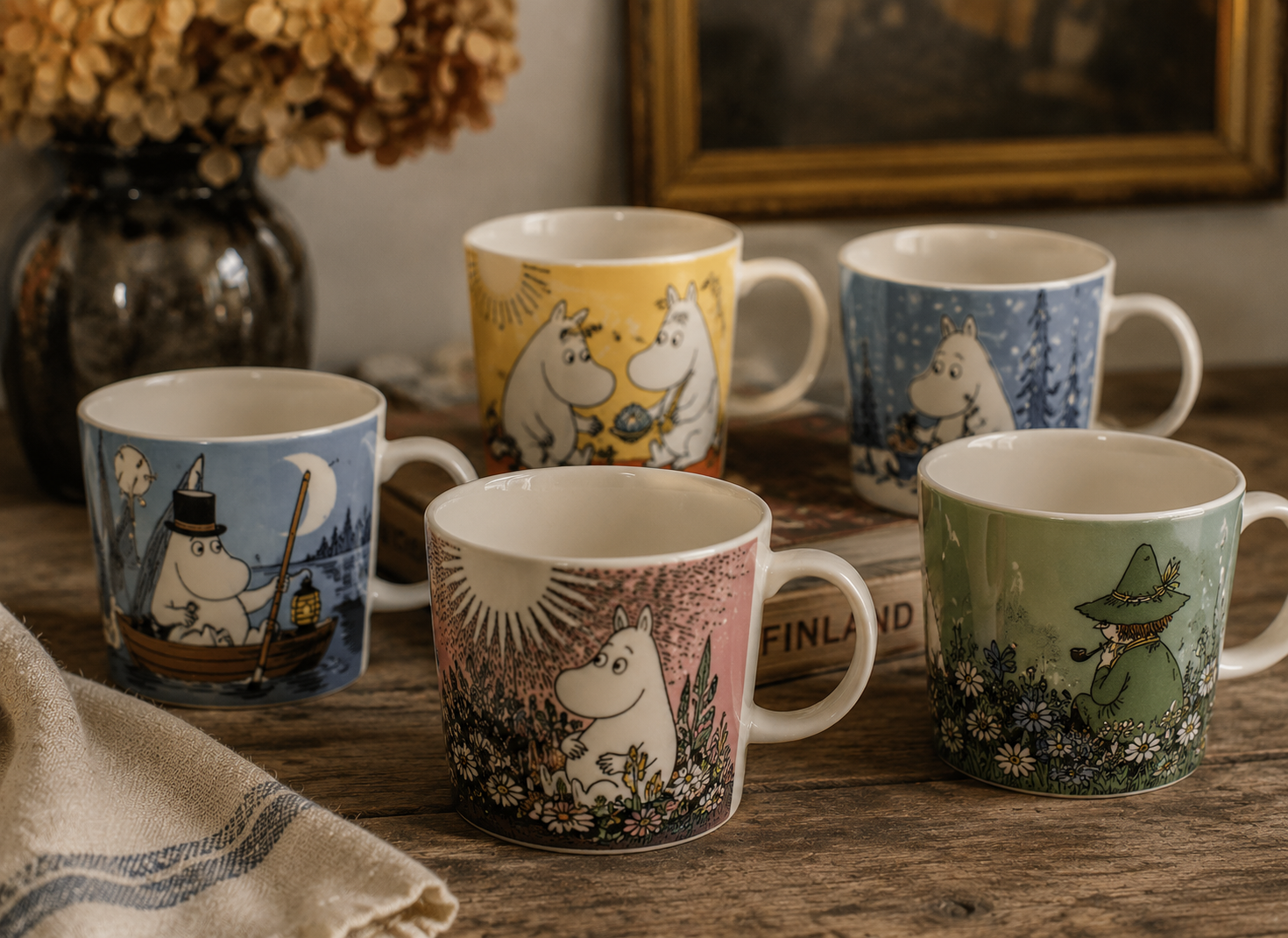
The first Moomin figure on an Arabia mug was launched in 1990 and has since become one of the world's best-known collectible items in ceramics. New motifs are launched every year, and retired motifs rise in value.
The most expensive Moomin mugs at auction include: "Moominmamma Hanging Up the Washing" (2004, retired motif) – 3,000–8,000 kr. Early versions of "The Fillyjonk" – 2,000–5,000 kr. Misprinted mugs with colour deviations – up to 15,000 kr for extremely rare variants.
The basic rule: the older and the shorter the production run, the higher the value. Original box and receipt preserve the value.
Loppos tip
Photograph the bottom mark straight on in good light — Loppos Scan recognises Arabia's different mark periods.
Ruska – the rustic everyday porcelain
The Ruska series was designed by Ulla Procopé in 1960 and is one of Arabia's most-loved everyday ranges – a coarse, dark unglazed stoneware in brown and beige that looks at home in a Finnish mountain kitchen. Ruska is still in production and can be bought new, which affects the value of older examples.
Vintage Ruska plates and cups at a flea market: 30–150 kronor each. A complete Ruska service in fine condition: 800–3,000 kronor.
Paratiisi – the Kaipiainen classic
Paratiisi (Paradise) was designed in 1969 by Birger Kaipiainen and is Arabia's most poetic series – a lush tropical bird design in deep blue tones that contrasts markedly with the Nordic minimalism that otherwise characterises the brand. The series was produced until 1974 and is today a sought-after collector's object.
Paratiisi plate, good condition: 200–600 kronor. Paratiisi coffee pot: 800–2,000 kronor. Complete service: rarely seen, but potentially 10,000+ kronor.
Kaj Franck's Kilta/Teema – the modernist classic
Kilta (1953, later redesigned as Teema in 1977) by Kaj Franck is Arabia's answer to the simplicity of industrial design – stackable, clean forms in a single-colour glaze. Kilta in its original form (marked "Kilta Finland") is more collectible than the later Teema production. A Kilta cup in a rare colour can fetch 300–800 kronor.