Art Nouveau and Art Deco are two of the most commonly encountered style eras on the antiques market, and they're often confused by anyone who has never had them explained. Both are beautiful, both are sought after – but they represent fundamentally different ways of looking at form, nature and modernity. This guide gives you the key to telling them apart at the flea market.
Art Nouveau: nature as form (1890–1920)
Art Nouveau – known as Jugend in Swedish and German – emerged as a reaction against the mass production of industrialism and against historicism's borrowing from bygone eras. The artists and designers wanted to create a wholly new visual language drawn from nature.
Keywords for Art Nouveau: flowing, organic, asymmetrical, nature motifs.
The visual language is dominated by winding lines that imitate the growth of plants – the tendrils of a lily, the wingspan of a dragonfly, the flow of hair. Furniture in the Art Nouveau style often has carved-out floral motifs, gently curved legs with a wooden foot ending in a claw, and back splats shaped like hearts or leaf forms.
Typical materials: Mahogany, walnut, enamel, leaded glass, wrought iron. Ceramics with a matt glaze in green, brown and blue tones.
Swedish Art Nouveau furniture is often more geometric than the French and Belgian originals – influences from Vienna (Josef Hoffmann, Otto Wagner) gave a stricter visual language, with carved-out apples and pears in the chair back as a typical feature.
Time period: Approx. 1890–1920. In Sweden, Art Nouveau was at its strongest around 1900–1915.
Art Deco: the machine as ideal (1920–1940)
Art Deco emerged partly as a reaction against the soft, organic visual language of Art Nouveau. The optimism of the 1920s – jazz, the breakthrough of cinema, the aeroplane and the car – created a new ideal: fast, streamlined, powerful and geometric.
Keywords for Art Deco: geometric, symmetrical, streamlined, luxury materials.
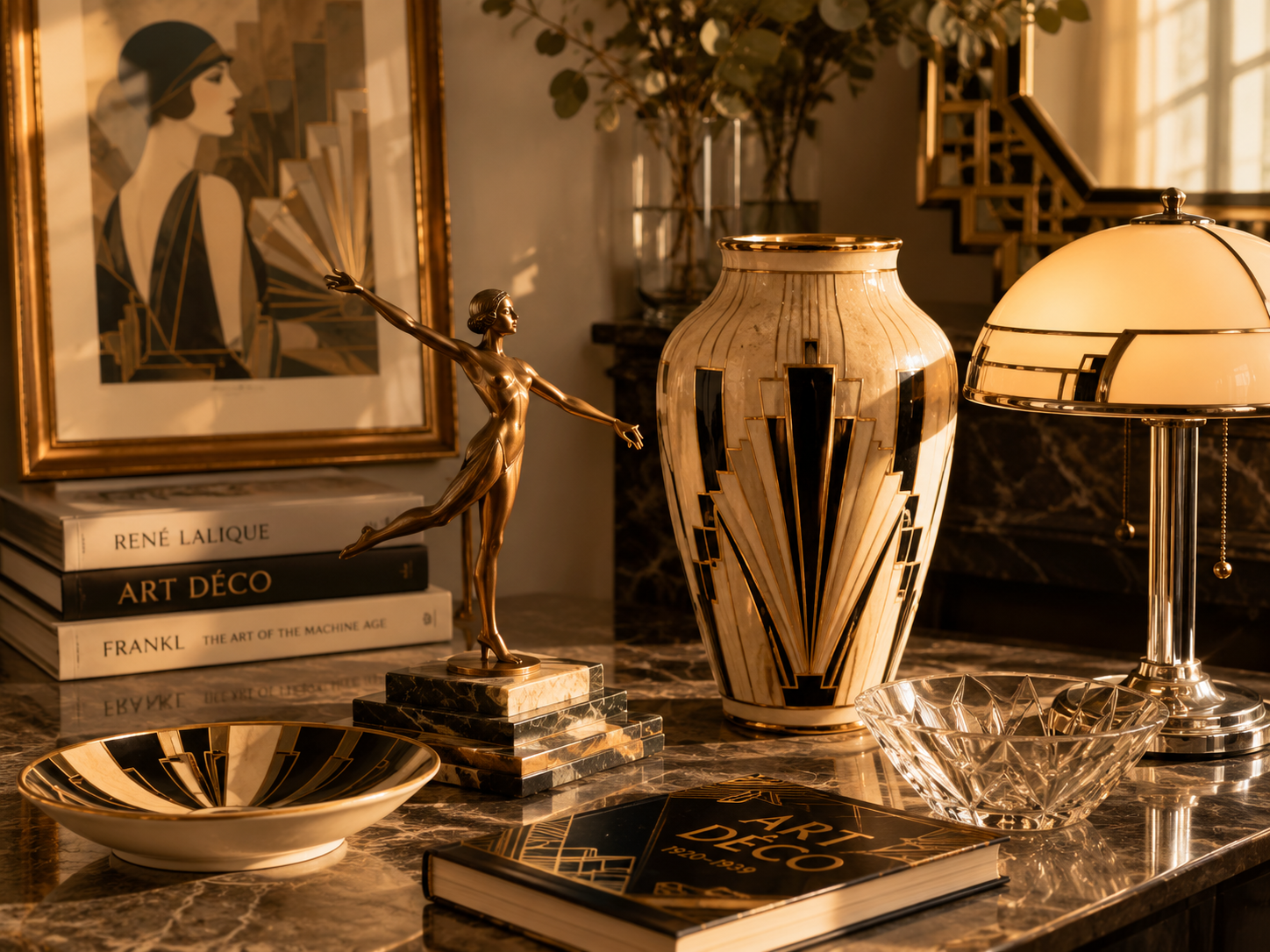
The visual language is dominated by straight lines, triangles, circles and right angles. The decoration is stylised and pared down – sunbursts, zigzag patterns, palm-leaf fans and abstract geometric ornaments replace Art Nouveau's naturalistic flowers and insects.
Typical materials: Lacquer, ivory, zebra skin, chrome, Bakelite, mirror glass. Furniture in veneered exotic woods such as zebrano, rosewood and Macassar ebony.
Art Deco furniture is straight, symmetrical and radiates a certain understated luxury. Sideboards with geometric inlays, rounded sofas with strong straight armrests, lamps in frosted glass with geometric metalwork.
Time period: Approx. 1920–1940. In Sweden, Art Deco dominated around 1925–1935.
Loppos tip
Save your favourite pieces under a theme in the app. Loppos groups them automatically by style so you can quickly spot the pattern in what draws you — and you get notifications when similar finds turn up near you.
The four quickest differences
Lines: Art Nouveau = curved and organic. Art Deco = straight and geometric.
Motifs: Art Nouveau = flowers, insects, female figures with flowing hair. Art Deco = geometric patterns, stylised sunrays, zigzags.
Symmetry: Art Nouveau = often asymmetrical. Art Deco = nearly always symmetrical.
Materials: Art Nouveau = dark wood and natural materials. Art Deco = lacquer, chrome and exotic veneers.
Overlaps and in-between styles
There is a significant overlap between the two. Swedish furniture from the 1910s often blends Art Nouveau's lines with an emerging geometrisation. Wiener Werkstätte influences created an in-between style known as geometric Art Nouveau – strict forms but with delicate organic decoration.
Don't put too much weight on classifying things exactly: a beautiful piece is beautiful regardless of which decade it belongs to. Knowing the style eras does, however, help you date, value and communicate what you have.