The period 1950–1970 is Scandinavia's golden age of design. During those two decades, Danish, Swedish, Norwegian and Finnish designers created furniture, glass, ceramics and textiles that are still regarded as among the finest industrial design ever produced. Today, pieces from this period are hotly sought after worldwide – and turn up at flea markets and auctions across Sweden at regular intervals.
What defines the style?
Nordic modernism rested on three principles: function, honesty in materials and simplicity of form. The furniture should be comfortable to sit in, the material should be visible and honest (no veneer, no fake wood) and the form should be free of unnecessary decoration.
Danish furniture design led the way. The "Danish Modern" philosophy – a focus on function, clean lines, solid wood, leather and high craftsmanship – was exported globally through a major exhibition at the Brooklyn Museum in 1954.
Teak: the signature material of the era
Teak is the material that, more than any other, defines the era. Teak from South-East Asia was imported into Scandinavia in large volumes and transformed by Danish and Swedish joiners into furniture that combined the warm tone of the exotic material with Nordic simplicity of form.
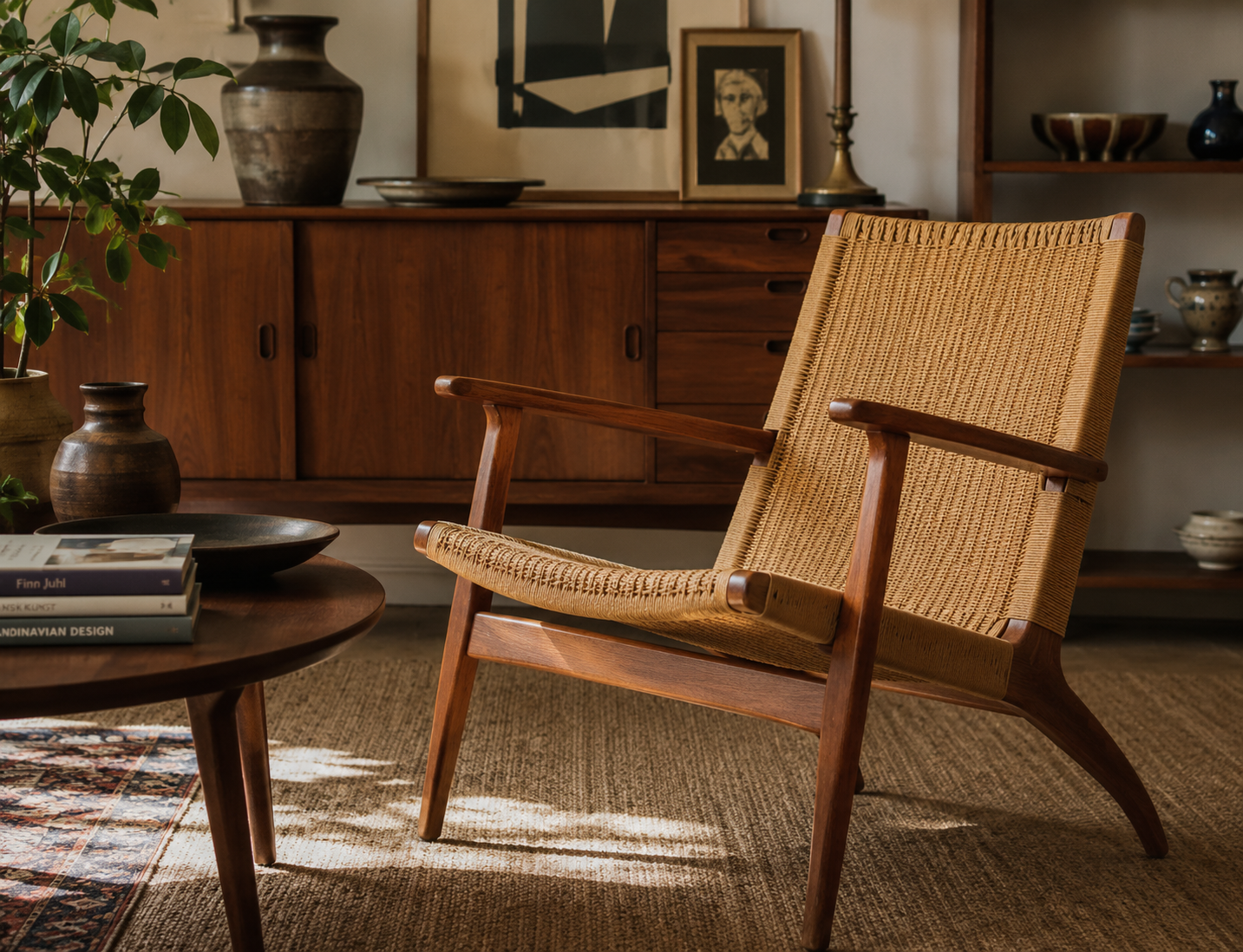
You can recognise teak furniture from 1950–1970 by: the warm yellow-brown to dark-brown tone; the wood's characteristic coarse texture with straight grain; solid construction – not hollow; sometimes combined with black iron or leather in the details.
Rosewood (palisander) is even more exclusive and was used by the leading Danish designers. A genuine rosewood sideboard by Arne Vodder or Kai Kristiansen is worth 20,000–80,000 kronor on today's market.
Designers to recognise
Arne Jacobsen (Denmark) – the Ant (1952), the Egg and the Swan (1958). These moulded plastic chairs are reproduced in hundreds of thousands today; a genuine vintage example from Fritz Hansen has a serial number under the seat.
Hans Wegner (Denmark) – The Chair (1949), the Wishbone Chair (1949). Solid construction, a hand-woven seat of paper or hemp cord, a stamp from Carl Hansen & Søn.
Alvar Aalto (Finland) – bent birch and basket-weave technique. The stamp "Artek Finland".
Bruno Mathsson (Sweden) – curved birch legs and a woven seat of hemp webbing. The stamp "Bruno Mathsson, Värnamo".
Yngve Ekström (Sweden) – the Lamino armchair (1956), produced by Swedese. One of the most highly valued Swedish armchairs in the vintage segment.
Loppos tip
Always turn the chair over — the label under the seat often makes the difference between a couple of hundred kronor and several thousand.
What is it worth?
The price spectrum is enormous. An unattributed teak sideboard in fine condition: 1,500–5,000 kr. A signed Hans Wegner Wishbone Chair, original: 4,000–10,000 kr per chair. An Arne Jacobsen Egg in original Kvadrat fabric: 25,000–60,000 kr. A Lamino armchair by Yngve Ekström, early example: 8,000–20,000 kr.
How do you identify an original?
A stamp or label under the seat or on the underside of the piece – the maker's name, the designer's name and sometimes a production year.
Material: genuine teak or rosewood, never plastic imitation. The construction should be solid hardwood or bent plywood, never chipboard.
Seat and upholstery: original Hans Wegner chairs have a hand-woven seat of paper or hemp cord. A replaced seat reduces the value but does not rule out authenticity if everything else matches.
Proportions: look at images of known original descriptions. Copies rarely keep the exact proportions and detail solutions of the original.
Tip: what to stop ignoring at the flea market
Teak sideboards and display cabinets without a stamp are the most common – they were made by hundreds of smaller Danish and Swedish furniture factories and are still very usable and beautiful home-furnishing objects, even without a designer's stamp. Price 500–2,000 kr. Upholstered armchairs with slim legs – always check the leg stamp if possible. Teak trays, cutlery and table accessories – often stamped and cheap at flea markets, easy to take home.