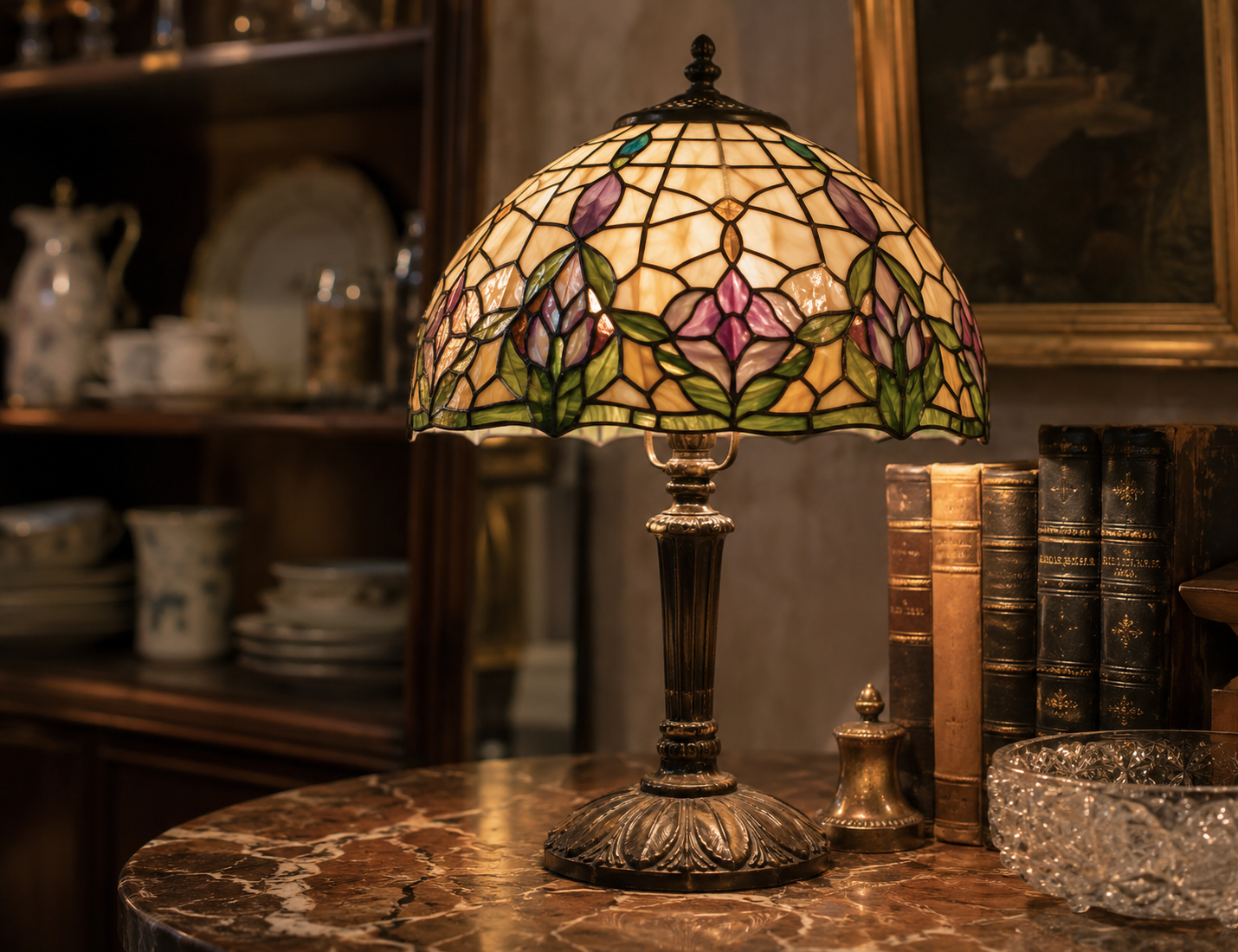
Tiffany lamps are among the most forged objects on the antiques market the world over. The originals from Tiffany Studios (active 1893–1933) are worth astronomical sums – a single example can sell for millions of kronor at Christie's or Sotheby's. But there is a scale of in-between cases: genuine vintage reproductions from the 1950s–1980s, modern mass-produced copies and – actual original pieces that turn up at flea markets without the seller knowing what they have.
This guide helps you understand where on that scale an object sits.
What is a "genuine" Tiffany original?
Louis Comfort Tiffany founded Tiffany Studios in New York in 1893. In the period up to 1933, lampshades were produced from leaded Favrile glass – a patented glass with a characteristic iridescence, depth and irregular texture that cannot be imitated industrially.
The original stamp sits on the base and reads "TIFFANY STUDIOS NEW YORK" followed by a model number. A genuine Tiffany Studios lamp costs at least 100,000 kronor on today's market, and the most sought-after models (Wisteria, Peony, Dragonfly) sell for 2–15 million kronor.
The Favrile glass – the key to authenticity
The most important test is the glass itself. Tiffany Favrile glass has a deep iridescence – a rainbow effect that shifts in the light and seems to come from within the material. It is opaque but not impenetrable, and the variation in texture is hand-made and organic.
Modern copies and mass-produced reproductions use industrial glass with printed or painted iridescence – the shimmer sits on the surface and lacks depth. Hold the shade up to a strong lamp and look at the glass: in an original the light seems to move inside the material.
The soldering and the construction
The original's lead framework – the network of lead strips that holds the glass pieces together – is hand-made and irregular. Under a magnifying glass you can see that the strips are not perfectly even and that the solder points vary in shape.
Modern mass-produced lamps have machine-made soldering with perfect, identical joints. If it is too symmetrical, that is a sign of mass production.
Loppos tip
A genuine Favrile shade weighs surprisingly much. If the lamp feels light and plasticky in the glass, it is almost always a later copy.
The base and the stamp
Original bases were made in bronze with patination in dark brown, gold or silver tone and are heavy and solid. The stamp "TIFFANY STUDIOS NEW YORK" plus a model number should be cast into the bronze – not printed, painted or glued on.
Warning: there are well-made forgeries with a correct stamp. A stamp alone does not confirm authenticity – the glass and the soldering must match as well.
Vintage reproductions – a category of their own
During the 1950s–1980s, Tiffany-inspired lamps of high craftsmanship were produced in Europe and the USA, sometimes by glass artists with real skill. These are not Tiffany Studios originals but can have an antique value of their own of 3,000–30,000 kronor if they are well made and in fine condition.
These are correctly called "Tiffany-style" or "vintage Tiffany-inspired" – not originals. They always lack the "Tiffany Studios New York" stamp.
If you think you've found an original
Don't buy on impulse. Take photographs of the stamp, the base, the soldering and at least three glass pieces in the shade. Contact an auction house with experience in art glass (Bukowskis, Bonhams, Christie's) for a preliminary valuation. Genuine Tiffany Studios lamps should always be professionally verified before purchase or sale.